 Moolish
Part 7 of 8 in TD Sequential
Learn · TD Sequential
TD perfected setup explained: the bar 8 or 9 test
Last updated:
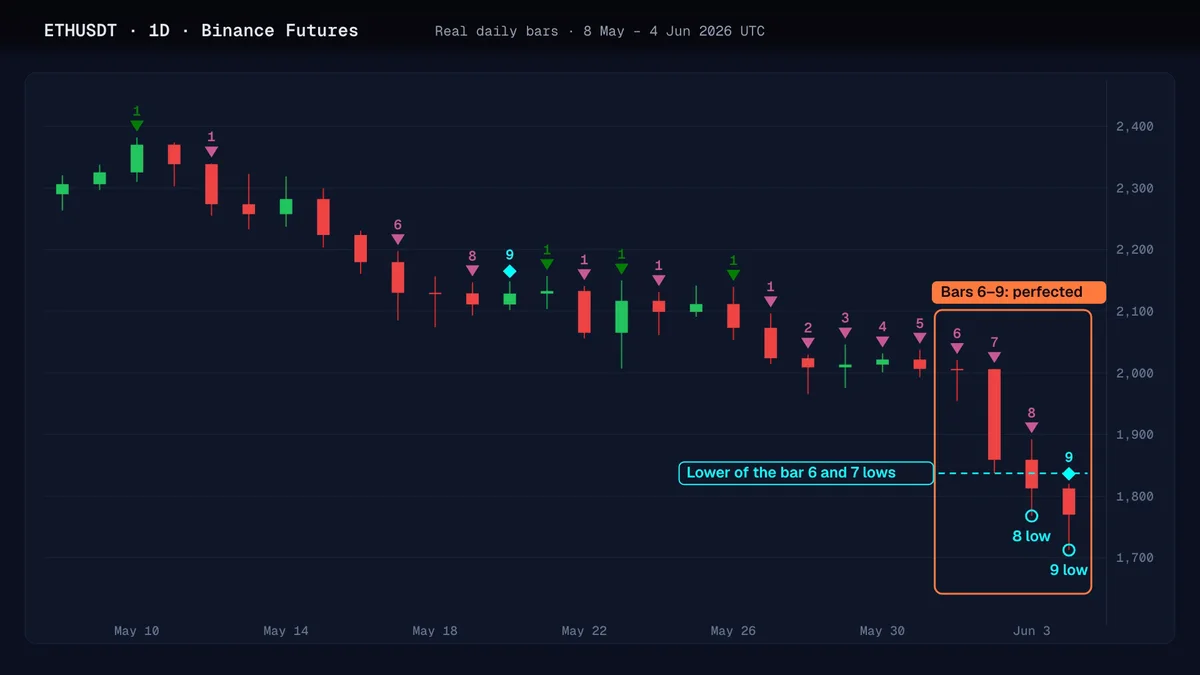
A perfected setup is a completed nine-bar TD Setup whose last bars also push beyond the earlier ones. For a buy setup, the low of bar 8 or bar 9 is below the lows of bars 6 and 7. A sell setup mirrors this with highs. It is a stricter reading of a 9, not a signal. Moolish’s scanner does not flag perfection, so you check it on the chart.
Everything below is education about the rule. It uses a worked example with made-up numbers, covers the variants you will meet and says what perfection does and does not tell you. If you are new to the count, read the TD9 explainer first.
Moolish is not affiliated with, endorsed by or sponsored by Tom DeMark or DeMARK Analytics. TD Sequential, TDST and TD Perfected Setup are terms from their method. Moolish’s own implementation of the counts is called Sequencer 9-13.
The perfected setup rule in one sentence
A completed buy setup is perfected when the low of bar 8 or the low of bar 9 is below the lows of both bar 6 and bar 7. A completed sell setup is perfected when the high of bar 8 or bar 9 is above the highs of both bar 6 and bar 7. DeMARK’s wording for the rule is that bars 6 and 7 have been “exceeded”, and some tools also accept an equal value.
The idea is that the end of the run should push a little further than the bars just before it. A setup that ends by drifting sideways, with bars 8 and 9 sitting inside the range of bars 6 and 7, has the right number of bars but a weaker finish. That describes the shape of the finish, not a measured outcome.
A worked example
These numbers are invented to show the arithmetic. They are not market data. Take a buy setup that has just completed and look only at the lows of bars 6 to 9.
| Setup | Low of bar 6 | Low of bar 7 | Low of bar 8 | Low of bar 9 | Perfected? |
|---|---|---|---|---|---|
| A | 100 | 98 | 99 | 95 | Yes: bar 9 (95) is below both 100 and 98 |
| B | 100 | 98 | 99 | 99 | No: neither bar 8 nor bar 9 is below 98 |
In setup A, bar 9 is lower than both bar 6 and bar 7, so the test passes. In setup B, bars 8 and 9 stay above the lower of the two earlier lows, so the test fails. Both are still complete setups with a 9 under them. The only difference is the finish.
Variants you will meet
Perfection is a place where tools and write-ups differ, so check which version a chart uses before comparing two of them.
- “8 or 9” versus “8 and 9”. Most descriptions say bar 8 or bar 9. Some write the rule as both. The second is stricter.
- Strict versus equal. A strict version needs the low to be beyond the earlier lows. A lenient one lets an equal value pass.
- Display. DeMARK’s own TradingView script marks a perfected 9 with a solid blue dot and has a setting to switch perfection on or off. Other tools use a different symbol or none.
What perfection is used for
Practitioners who rely on perfection use it as a filter. They wait for a perfected 9, or they treat an imperfect one as a weaker prompt. That is a choice about how to read the count, not part of the counting itself. A setup without perfection is still a setup, and the countdown can still start from it.
It is worth being plain about the evidence. We found no independent source that measured whether perfected setups behave differently from other setups, so this page makes no claim that they do. Treat any statement of that kind as a belief about the method until you have checked it on charts yourself.
Perfection and the scanner
Moolish’s scanner does not flag perfection. Sequencer 9-13 reports that a Buy Setup 9 or Sell Setup 9 closed, and that is all it says about the setup’s shape. The signal names in the picker do not include a “perfected” label.
That means perfection is a reading step you apply yourself. When a scan returns a Buy Setup 9, open the chart, find bars 6 to 9 and compare the lows by eye or with the crosshair. The free TD Sequential count checker is a good place to practise the counts on a symbol before you scan. For how perfection fits a wider routine, see the strategy page, and for the level that comes from the same nine bars, see TDST explained.
To scan 1,600+ crypto markets for fresh 9s on ten timeframes from 15M to 3M, start the free 7-day trial (no credit card) and use the app. The scanner reports the count; you decide whether the shape matters to you.
What perfection does not tell you
- It gives no direction. A perfected buy 9 still flags a stretched decline, not a rise.
- It gives no timing. Price can continue for many bars after a perfected 9.
- It gives no stop or size. You still choose where you are wrong.
- It can be close to the line. Whether bar 9 is lower than bar 7 by a hair or by a lot makes no difference to the rule, and it may matter a great deal to how you read the chart.
- It depends on the data. Wicks differ between venues, so the same setup can be perfected on one exchange’s chart and not on another’s.
Nothing on this page is financial advice. Trading crypto carries a high risk of loss.
FAQ
What is a perfected setup in TD Sequential?
A perfected setup is a completed nine-bar setup whose bar 8 or bar 9 reaches past bars 6 and 7. For a buy setup, the low of bar 8 or 9 is below the lows of bars 6 and 7. For a sell setup, the high of bar 8 or 9 is above the highs of bars 6 and 7.
Is a perfected 9 more reliable than a normal 9?
We found no independent source that measured it, so we make no such claim. Practitioners use perfection as a filter, or treat an imperfect 9 as a weaker prompt, but that is a reading choice. Neither kind gives direction or timing.
Does Moolish mark perfected setups?
No. The scanner reports Buy Setup 9 and Sell Setup 9 when the nine-bar count completes, and does not flag perfection. If perfection matters to you, check bars 6 to 9 on the chart after a scan returns a match.
Is it bar 8 or 9, or bar 8 and 9?
Most descriptions say bar 8 or bar 9, and some write both. The second is stricter, and some tools also accept an equal value. Read the rule your chart or script uses before comparing it with another one.
Can a setup be a valid 9 without being perfected?
Yes. A setup is complete after nine qualifying closes. Perfection is an extra test on the same bars, and the countdown can start from a setup that is not perfected. Whether to treat it as weaker is your choice.
Sources
Read from each public page on the date shown. Check the page itself before you decide, because products and prices change.
- https://www.tradingview.com/script/gVMuxasg-DeMARK-9-13/, checked October 28, 2026. DeMARK states: 'The Setup is Perfected when the 9 is completed and the 6 and 7 bars have been exceeded.' For a buy setup the low of bar 8 or 9 must be below the lows of bars 6 and 7; for a sell setup the high of bar 8 or 9 must be above the highs of bars 6 and 7. The script marks a perfected setup with a solid blue dot and has a Setup Perfection setting.
- https://github.com/ourarash/tdsequential, checked October 26, 2026. An MIT-licensed Node.js package that returns per-bar setup and countdown counts and flags including perfection and TDST levels.
Ask an AI to check this page