 Moolish
Part 2 of 8 in TD Sequential
Learn · TD Sequential
TD9 indicator explained: the nine-count setup
Last updated:
TD9 is a completed nine-bar TD Setup from Tom DeMark’s TD Sequential method. A buy 9 follows nine closes that are each lower than the close four bars earlier, and a sell 9 nine that are each higher. It is a prompt to look at the chart, not a trade signal and not a confirmed reversal.
The name is shorthand. Traders write “TD9” for the moment a chart prints the number 9 under a bar. This page explains what had to happen for that 9 to appear, what separates a buy 9 from a sell 9, and what the number cannot tell you.
Moolish is not affiliated with, endorsed by or sponsored by Tom DeMark or DeMARK Analytics. TD Sequential is their method. Moolish’s own implementation of these counts is called Sequencer 9-13.
How the nine is counted
Each bar’s close is compared with the close four bars earlier. For a buy setup, the close must be lower than that earlier close. For a sell setup, it must be higher. When nine bars in a row pass the test, the setup is complete and the ninth bar carries the 9.
The run must be unbroken. The first bar that fails the comparison resets the count to zero, and counting starts again from the next qualifying bar. A 7 followed by a failing bar does not pause at 7; it starts over.
One detail differs between descriptions. DeMark’s own description also expects a price flip before the setup starts: one close above the close four bars earlier, then the first close below it starts the count. The Moolish engine does not wait for a flip. It counts consecutive closes against the close four bars earlier and resets on the first failing bar. Check which version your tool uses before comparing two charts.
Buy 9 and sell 9
The two versions mirror each other. The word “buy” names the kind of exhaustion being flagged, a falling run that may be stretched. It is not an instruction to buy.
| Version | Direction of closes | What it marks | Moolish event name |
|---|---|---|---|
| Buy 9 | Nine closes, each below the close four bars earlier | A falling run that may be stretched | Buy Setup 9 |
| Sell 9 | Nine closes, each above the close four bars earlier | A rising run that may be stretched | Sell Setup 9 |
Perfected 9
Not every 9 is treated the same. A buy 9 is called perfected when the low of bar 8 or bar 9 is below the lows of bars 6 and 7 (DeMark’s word is “exceeded”; some tools also accept an equal low). A sell 9 is perfected when the high of bar 8 or bar 9 is above the highs of bars 6 and 7, with the same caveat.
Moolish reports counts, not perfection. The scanner tells you that a Buy Setup 9 closed. Whether it was perfected is a reading rule you apply to the chart.
What a 9 is not
- It gives no direction. A buy 9 flags a stretched decline. It does not say the market will rise.
- It gives no stop and no size. The count says nothing about where you are wrong or how much to risk.
- It repeats in trends. In a persistent move, new setups can complete again and again while the trend keeps going.
- It depends on the timeframe. A 9 on the 15M chart and a 9 on the 1W chart use the same arithmetic, but they are not the same event. The weekly one spans nine weeks of trading.
- It is not the whole method. The countdown to 13 is a separate phase that starts only after a setup has completed.
TD9 on a crypto chart
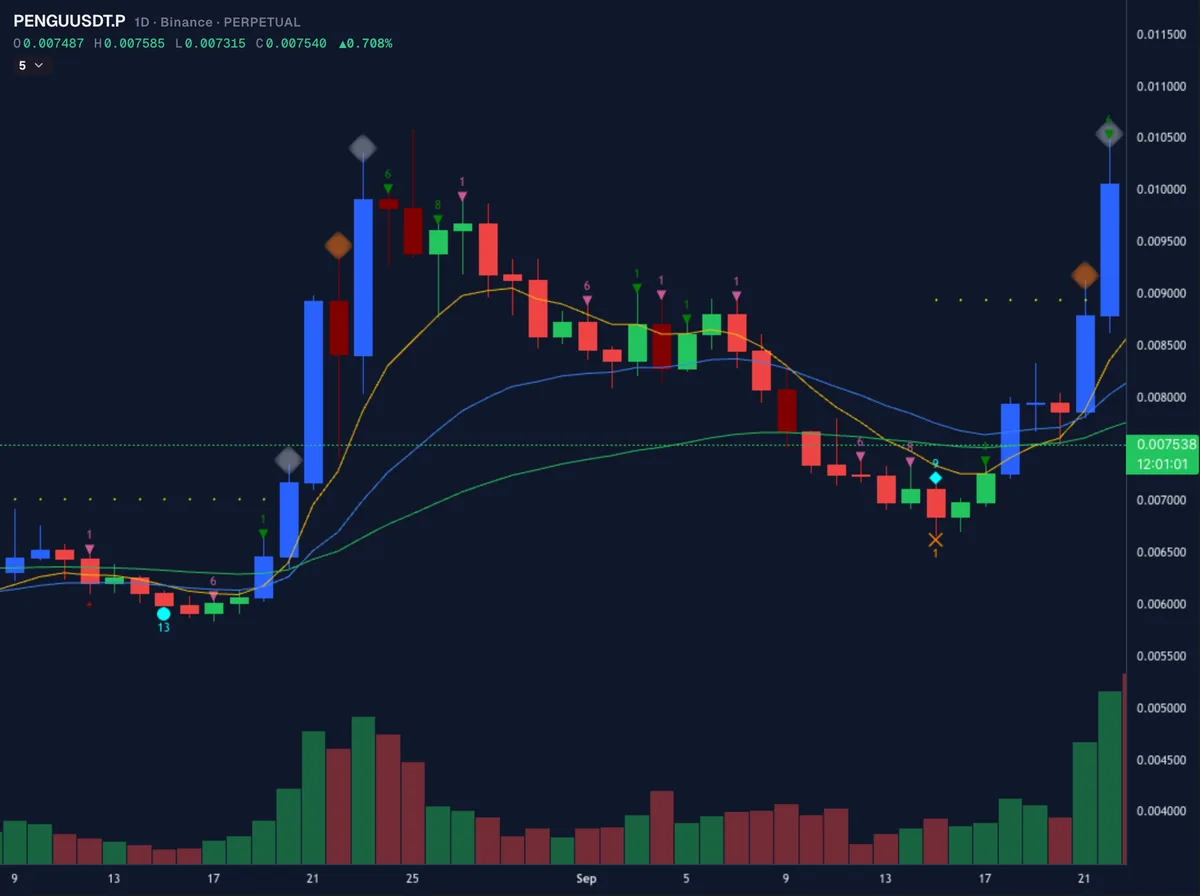
Crypto trades around the clock, so nine daily bars are nine calendar days, weekends included. The arithmetic is unchanged. What can differ between platforms is where a daily bar ends, so a count that is one bar off can point to a different bar boundary. Moolish daily bars open at 00:00 UTC.
The drawing above is the whole idea in one picture: nine closes in a row, each checked against the close four bars back. On a live chart the same nine bars carry the numbers 1 to 9 under them.
Scanning for 9s
Checking hundreds of charts for a fresh 9 by hand is slow, and a bar that closed while you were away is easy to miss. Moolish scans Buy Setup 9 and Sell Setup 9 on ten timeframes, from 15M to 3M, across 1,600+ crypto markets. You pick the signal and the timeframe, and the scanner lists the markets where it has just appeared on a closed bar. To check one symbol right now, the free TD Sequential counter shows its current setup count on closed bars.
The scanner reports what the rule detects. It does not tell you what to trade. The TD Sequential crypto scanner guide walks through the setup, the full TD Sequential explainer covers the whole method, and the TD Countdown 13 explainer covers the countdown that follows a 9.
FAQ
What is TD9?
TD9 is the setup: a completed run of nine consecutive closes, each compared with the close four bars earlier. It is a prompt to look, not a direction. The countdown to 13 is a separate step that can only begin after the setup has finished, so a TD9 alone is not a full sequential count.
Is TD9 bullish or bearish?
Neither. A buy 9 follows nine closes that are each below the close four bars earlier and flags a possibly stretched decline. A sell 9 follows nine that are each above it and flags a possibly stretched rise. The names describe the kind of exhaustion being counted, not a forecast, so a 9 gives no direction and no timing by itself.
Is TD9 the same as TD Sequential?
No. TD9 is the first phase of TD Sequential, the nine-bar setup. The full method adds a second phase, the countdown to 13, which starts only after a setup completes. People often say “TD9” for the whole indicator, but strictly it names just the setup and its ninth bar.
Does Moolish alert on TD9?
Moolish scans for Buy Setup 9 and Sell Setup 9 on ten timeframes, from 15M to 3M. You can save a Scan Events filter as a preset and switch on a Telegram alert, which sends one message when the preset finds new matches after a bar closes. The alert reports the count, not a trade.
Ask an AI to check this page