 Moolish
Part 4 of 8 in TD Sequential
Learn · TD Sequential
TD Sequential vs TD Combo: key differences
Last updated:
TD Sequential and TD Combo use the same nine-count setup. Sequential starts its 13-count countdown once the setup completes. Combo starts counting from the first bar of the setup and adds stricter bar-to-bar conditions, so its minimum length is shorter. Moolish scans the Sequential counts, not Combo.
What both methods share
Both methods come from Tom DeMark, and both are exhaustion tools. They count closed bars to mark where a move may be running out of steam. Neither forecasts a price, and neither is a command to trade.
The first phase is identical. A buy setup is nine consecutive closes, each below the close four bars earlier. A sell setup is the mirror: nine consecutive closes, each above the close four bars earlier. The sources checked say Combo uses the same setup criteria as Sequential, so everything you know about reading a 9 carries over.
Perfection is part of the setup, so it carries over too. A buy setup counts as perfected when the low of bar 8 or bar 9 is below the lows of bars 6 and 7 (DeMARK’s word is “exceeded”; some tools also accept an equal low), and a sell setup mirrors that with highs. None of the sources read discusses perfection for Combo separately, so treat that as an inference from the shared setup rather than a stated rule.
Moolish is not affiliated with, endorsed by or sponsored by Tom DeMark or DeMARK Analytics. TD Sequential and TD Combo are methods created by Tom DeMark. Moolish’s implementation of the TD Sequential counts is called Sequencer 9-13. Moolish does not implement TD Combo.
Where they differ
When the countdown starts
This is the difference every source we read agrees on. In TD Sequential, the countdown begins only after the nine-count setup has completed. The completing bar, bar 9, can itself count as countdown bar 1 if its close passes the countdown test. If it does not, countdown bar 1 is postponed until a later bar passes.
In TD Combo, the countdown can begin as early as bar 1 of the setup. The setup and the countdown therefore run in parallel for a while, instead of one after the other.
What the countdown requires
The basic test is the same in both. A buy countdown bar closes at or below the low of the bar two bars earlier, and a sell countdown bar closes at or above the high two bars earlier. Qualifying bars do not have to be consecutive.
Combo then adds conditions, and here the public sources are thinner. The TradingView description we read says only that Combo has “additional rules based on the Combo version selected” and does not spell them out. The table of contents of Jason Perl’s DeMark Indicators lists a strict Version I and a less strict Version II for both the buy and the sell Combo countdown, which fits that wording but gives no rules.
One MQL5 write-up does list rules for the buy side. In addition to the close-versus-low test, each countdown bar must have a lower low than the previous bar, a lower close than the previous bar, and a lower close than the previous countdown bar. The same write-up says bars 11 to 13 only need to close successively lower. We could not match this list to a second source, and it may describe one version only. Treat it as one description, and check the version your charting platform uses.
How long each takes
Because Combo can start at bar 1 and demands more of each bar, the sources describe a shorter minimum length for it. Both agree Combo can finish in as few as 13 bars. They differ by one bar on Sequential’s minimum: one says 12 bars after the setup, the other says at least 22 bars in total. In practice both counts usually run well beyond their minimums.
The two sources also disagree in tone on where each works. The TradingView page says Combo is more responsive in trending markets and inactive in consolidation, while Sequential responds in both. The MQL5 write-up says Combo suits sharp directional moves. Neither source offers evidence for those claims, so read them as descriptions of design intent.
Side by side
| Aspect | TD Sequential | TD Combo |
|---|---|---|
| Setup | Nine consecutive closes against the close four bars earlier | The same setup criteria |
| Countdown start | After the setup completes; bar 9 can be countdown bar 1 | As early as bar 1 of the setup |
| Countdown bars | 13 qualifying closes, not necessarily consecutive | 13 qualifying closes |
| Countdown conditions | Close at or below the low two bars earlier (buy), at or above the high (sell) | The same test plus extra bar-to-bar rules that vary by version; sources disagree on the detail |
| Minimum length | About 21 to 22 bars including the setup | As few as 13 bars |
| A completed 13 is read as | A possible point of trend exhaustion | A possible point of trend exhaustion, reached earlier |
| Available in Moolish | Yes, as Sequencer 9-13 | No |
Which one to watch
There is no source-backed answer to which is better, and any page that gives one is guessing. A fairer way to think about it is what each count tells you.
Combo’s earlier start can be informative in a steady, one-directional move. It flags a long run sooner, and its extra conditions screen out some bars that Sequential would count. That can help if you want an early prompt to look at the chart.
The same earlier start can be noise. A countdown that begins while the setup is still forming has seen less of the move, and in a choppy market a stricter bar-to-bar rule may simply never complete. A count that rarely finishes is hard to learn from.
Sequential’s slower, two-step structure is easier to explain and easier to check by eye: the 9 first, then the 13. Some traders watch both and treat agreement between them as extra context. That is a habit, not a tested rule.
Limits of both
- They are exhaustion methods. A completed 9 or 13 says a run of bars has lasted a defined length. It does not say when the move ends.
- They do not give direction or timing. A buy count after a long fall is a prompt to look, not an instruction to buy.
- Counts repeat in strong trends. A trend can complete several setups and countdowns in a row and keep going.
- Versions and platforms differ. Combo in particular has more than one published version, so two charts can show different counts for the same bars.
- Nothing here is a claim about results. This page describes rules. It does not show that either method makes money, and vendor backtests are not independent evidence.
Where the Moolish scanner fits
Moolish scans the TD Sequential counts. Its method, Sequencer 9-13, records events such as Buy Setup 9, Sell Setup 9, Buy Countdown 13 and Sell Countdown 13, along with Buy Countdown 1, Sell Countdown 1 and the support and resistance events the method tracks. It checks them across 1,600+ crypto markets on ten timeframes, from 15M to 3M, and detects each one on the closed bar.
On a chart, Sequencer 9-13 prints its counts as small numbers above and below the bars. Below is a daily ETHUSDT chart on Binance Spot covering about five months to 26 October 2026, with counts shown on both sides of the bars and the volume pane underneath.
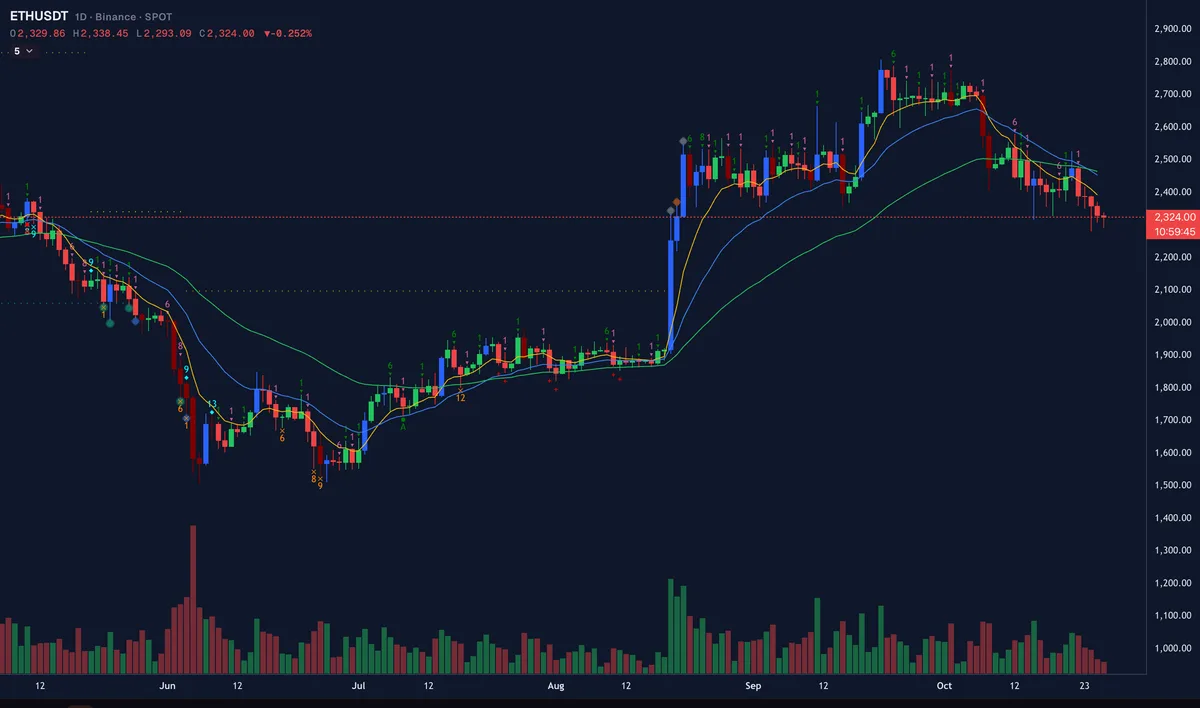
You can also require volume and candle confirmation. A Scan Events preset can ask for a Buy Setup 9 on the 1D, High Volume or above on the 4H and a Bullish Engulfing on the 15M, then send one Telegram alert when a market matches.
Moolish does not scan TD Combo. If your analysis depends on Combo counts, you will need another tool for them. The TD Sequential crypto scanner guide shows how the Sequential scan works, step by step.
FAQ
What is the difference between TD Sequential and TD Combo?
Both use the same nine-count setup. TD Sequential starts its 13-count countdown after the setup completes. TD Combo can start counting from bar 1 of the setup and adds extra bar-to-bar conditions, so the two can run in parallel on the same bars. The details of those conditions vary by version.
Does TD Combo complete faster?
It can. Public descriptions say Combo can finish in as few as 13 bars, while Sequential needs about 21 to 22 including the setup. Those are minimums, not typical lengths, and Combo's stricter conditions can also stop a count from completing.
Can both signal at the same time?
Yes. They share the same setup, so both can show a completed 9 on the same bar. Their 13-counts follow different rules and start points, so they can complete on different bars. When both finish near the same area, some traders read it as extra context, not as confirmation.
Does Moolish scan TD Combo?
No. Moolish scans the TD Sequential counts, under the method name Sequencer 9-13: setup 9, countdown 1 and 13, and related events on ten timeframes. It does not implement TD Combo, and it is not affiliated with Tom DeMark or DeMARK Analytics.
Sources
These public pages were read on 2026-10-26. Every rule above about Combo comes from them. None is DeMark’s own primary text, so check details against the book or your platform’s manual.
- TradingView script description, “DeMARK 9 13”: countdown start at bar 1 vs bar 9, version-dependent Combo rules, minimum length, trending vs consolidating behavior.
- MQL5 blog, “TOM DEMARK - TD SEQUENTIAL - TD COMBO”: same setup, count from bar 1, the buy-side condition list, bars 11 to 13.
- ProRealCode forum thread on TD Sequential: the Sequential countdown start, with bar 9 as countdown bar 1 or postponed. It does not cover Combo.
- Kinokuniya listing, Jason Perl, DeMark Indicators: table of contents showing Combo Version I (strict) and Version II (less strict) countdowns.
- Wiley-VCH listing, Jason Perl, DeMark Indicators: author and ISBN (978-1-57660-314-7) of the book cited above.
Ask an AI to check this page