 Moolish
Part 3 of 8 in TD Sequential
Learn · TD Sequential
TD Countdown 13 explained: what the DeMARK 13 means
Last updated:
A DeMARK 13 is a completed TD Countdown in Tom DeMark’s TD Sequential method. After a finished nine-bar setup, thirteen closes have met the countdown test, not necessarily in a row. It marks possible exhaustion of a longer move, not a confirmed reversal.
The countdown is the second phase of TD Sequential, and the 13 is its last number. This page explains where the count starts, which bars qualify, what the 13-versus-8 check does, and what a 13 cannot tell you.
Moolish is not affiliated with, endorsed by or sponsored by Tom DeMark or DeMARK Analytics. TD Sequential is their method. Moolish’s own implementation of these counts is called Sequencer 9-13.
Where the countdown starts
A countdown cannot begin until a setup has completed. The setup is the run of nine consecutive closes described in the TD9 explainer. Once it is done, the countdown starts looking for qualifying bars.
The setup’s own bar 9 can be countdown bar 1. In the Moolish engine, if that ninth bar also passes the countdown test, it counts as the first countdown bar. If it fails the test, counting begins with the next bar that passes.
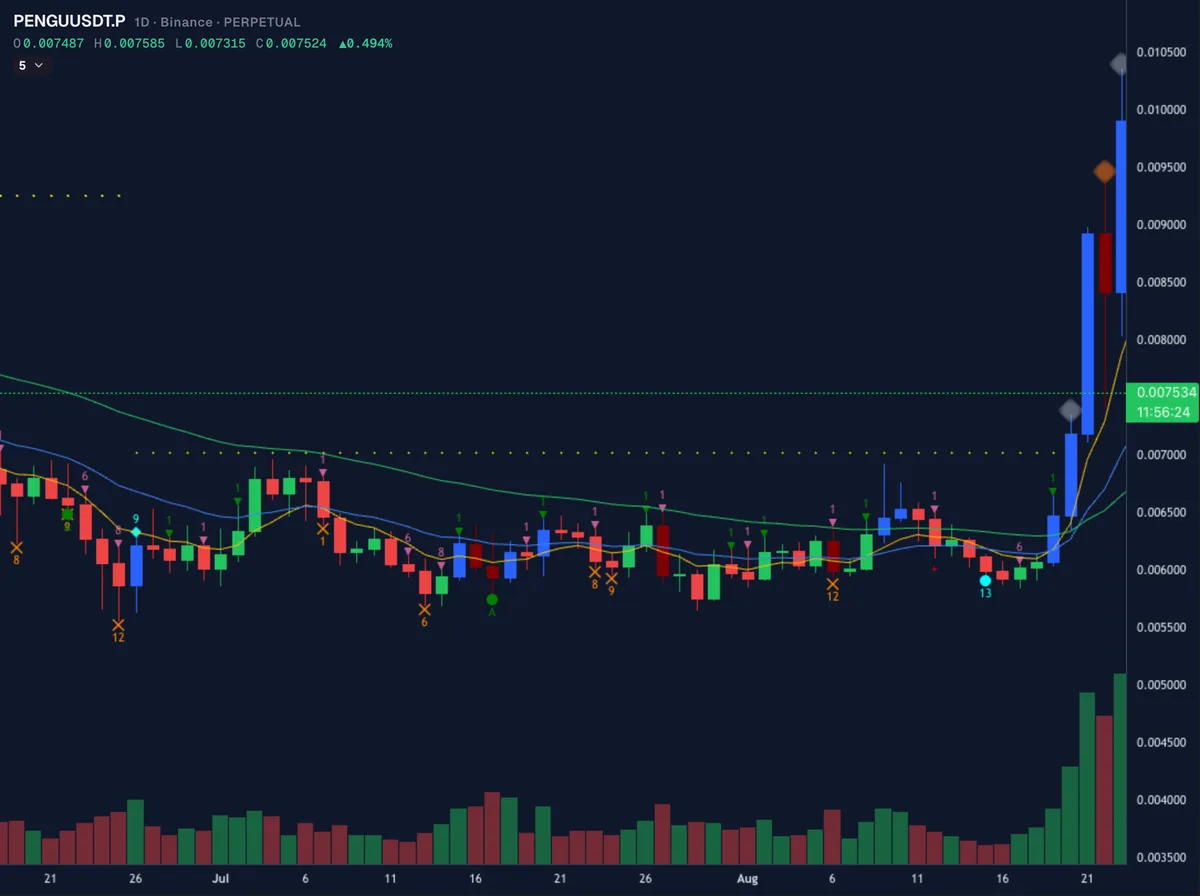
What qualifies a countdown bar
A countdown bar is judged against a bar two bars earlier, not four.
- Buy countdown: the close is at or below the low of the bar two bars earlier.
- Sell countdown: the close is at or above the high of the bar two bars earlier.
The qualifying bars do not have to be consecutive. A bar that fails the test is simply not counted, and the count carries on to the next bar that passes. That is why a countdown often takes far longer than the setup did, and why the figure below has unmarked bars between the counted ones.
The 13-versus-8 check
Many descriptions add a final test on the thirteenth bar. In DeMark’s description, for a buy countdown the low of bar 13 must be at or below the close of countdown bar 8. If it is not, the 13 is not accepted yet and the count is deferred until a later bar satisfies the check. A sell countdown mirrors this with the high.
The Moolish engine records the close of countdown bar 8 for exactly this comparison. Other tools may handle the check differently, so read your tool’s documentation before comparing counts.
Reading a 13
The 9 and the 13 answer different questions. A 9 says a short run was one-sided. A 13 says a longer stretch kept closing beyond the range of the bar two earlier.
| Phase | Bars | Consecutive? | Moolish event names | What it marks |
|---|---|---|---|---|
| Setup | 9, each against the close four bars earlier | Yes | Buy Setup 9, Sell Setup 9 | A short run that may be stretched |
| Countdown | 13, each against the high or low two bars earlier | No | Buy Countdown 1, Buy Countdown 13, Sell Countdown 1, Sell Countdown 13 | A longer move that may be exhausted |
Non-qualified and cancelled counts
A 13 whose 13-versus-8 check fails is deferred, not completed. A countdown ends when a setup in the opposite direction completes: a finished Sell Setup 9 stops a running buy countdown, and the reverse. This is how Sequencer 9-13 behaves; other descriptions add further cancellation and recycling rules.
Moolish lists Non-qualified Buy 13 and Non-qualified Sell 13 as separate events, apart from Buy Countdown 13 and Sell Countdown 13. Treat the two families as different readings of the same stage.
What a 13 is not
- It is not a reversal. Price can keep moving in the same direction for many more bars.
- It gives no timing, stop or size. The count says nothing about when or where you are wrong.
- It does not always complete. A countdown can stall, be deferred, or be ended by a completed setup in the opposite direction before it reaches 13.
- It depends on the timeframe. A 13 on the 15M chart and a 13 on the 1W chart are different events.
Scanning for 13s
A countdown can run for weeks, which makes it easy to lose track of. Moolish scans Buy Countdown 13 and Sell Countdown 13 on ten timeframes, from 15M to 3M, across 1,600+ crypto markets, and lists markets where the event has just appeared on a closed bar. The scanner reports what the rule detects, not what to trade. The TD Sequential crypto scanner guide shows the steps. To check a single symbol right now, the free TD Sequential counter shows its current countdown on closed bars.
FAQ
What does DeMARK 13 mean?
A DeMARK 13 is a completed TD Countdown. After a valid nine-count setup, thirteen closes have met the countdown test, not necessarily in a row. For a sell, each close is at or above the high two bars earlier; for a buy, at or below the low. It marks possible exhaustion, not a confirmed reversal.
How long does a countdown take?
There is no fixed length. Thirteen bars must qualify, and they need not be consecutive, so a countdown always needs at least thirteen bars and often far more. It can also stall, be deferred by the 13-versus-8 check or be ended by a completed opposite setup before it finishes. The figure above spans twenty bars.
Can a countdown start before the setup completes?
Not in TD Sequential. The countdown waits for a completed nine-bar setup, although the setup’s bar 9 can itself be countdown bar 1. TD Combo differs: it can begin counting at bar 1 of its setup. The TD Sequential vs TD Combo page sets out the difference.
Does Moolish alert on Countdown 13?
Moolish scans Buy Countdown 13 and Sell Countdown 13 on ten timeframes, 15M to 3M. Save a Scan Events filter as a preset and switch on a Telegram alert to get one message when it finds new matches after a bar closes. The alert reports the count, not a trade.
Ask an AI to check this page